Guide · updated 2026-10-26
Why Epoxy Floors Peel
Epoxy floors peel when the film lets go of the layer under it. That layer might be weak concrete, dust, oil, moisture-driven pressure, or an older coat that was never a sound base. The symptom is a sheet or a flake with a back you can look at. The cause is usually one of a few categories. Confirming which one takes a look at the slab, not a guess from a single photo, but the photo still helps.
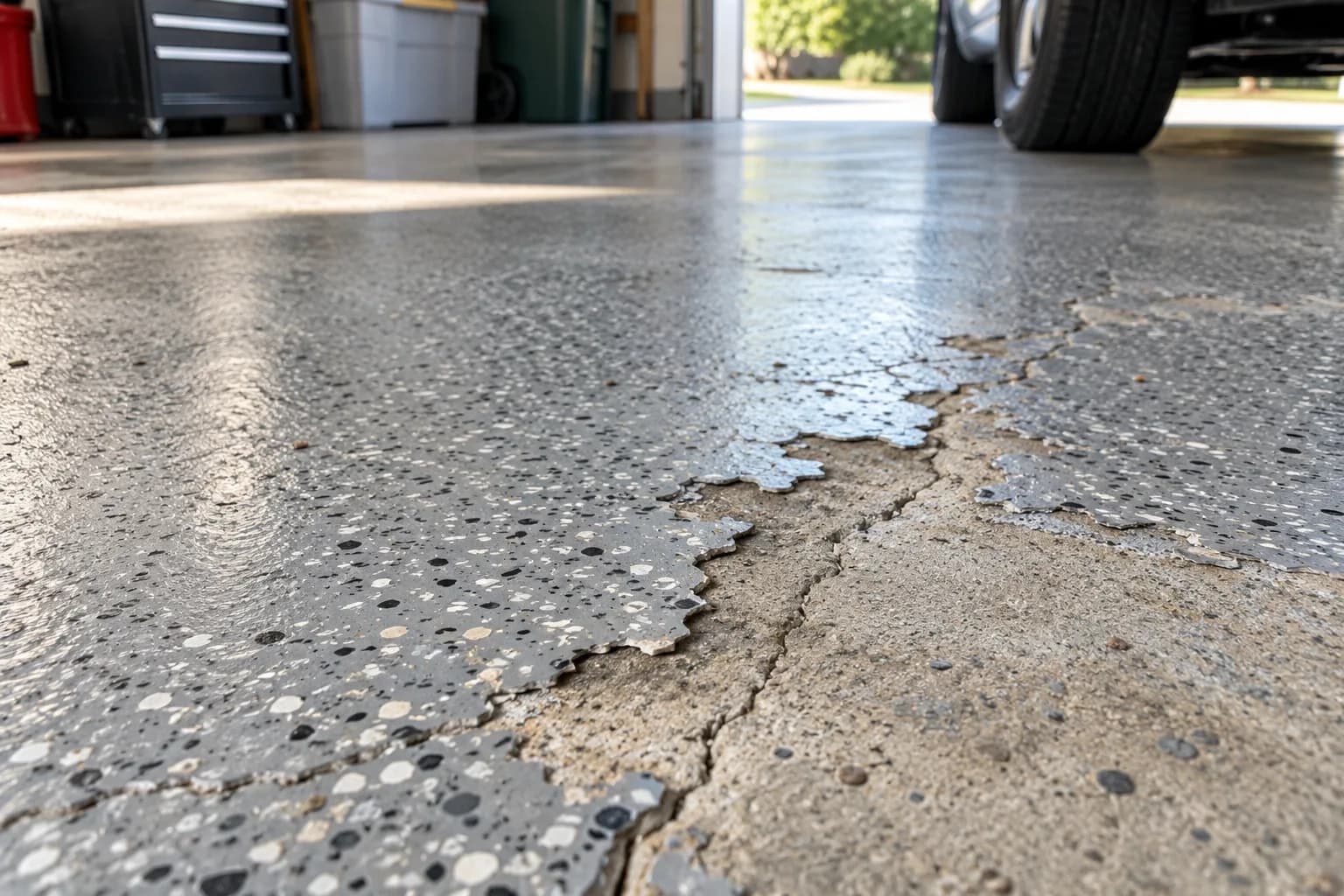
What you can observe safely
Look at a piece that has already detached. A dusty or chalky back often means the coating grabbed weak paste or laitance and left the real concrete behind. A shiny back that looks like the coat underneath failed between layers. A pattern of blisters, especially with liquid or a dark damp spot, belongs in the moisture category until someone shows otherwise. Peeling that starts at a control joint or a crack may be movement, not a bad colour coat.
Note how far it has spread and whether the rest of the floor sounds solid underfoot. Do not grind, solvent-wash, or heat the film to “test” it. Older coatings and resin dust are a chemical and dust-control issue. CCOHS chemical-hazard material is general workplace guidance for crews, not a home recipe.
Cause categories that show up repeatedly
Preparation: no mechanical profile, acid-etch residue, or coating over a sealer. Contamination: oil, tire dressing, or silicone that never came out of the pores. Moisture: vapour from a slab on grade, or water entering from the side, pushing a tight film into blisters. Incompatibility: a new coat outside the recoat window or over a chalking surface. Under-cure or over-spread resin can also fail early, which is an installation problem rather than a slab problem.
More than one can be true. A garage can have oil in one bay and a damp crack at the door. Preparation prevents the first category. It does not, by itself, solve liquid water.
Spot repair, removal, and the quote
If the chip back is clean sound coating and the area is tiny, a compatible patch may be discussable. If the back is concrete dust or the blisters keep coming, plan on removal to a sound profile and a system rated for what the slab is doing. Testing, such as in-situ relative humidity when moisture is plausible, is a professional step. Repair or recoat and the repair request are the next pages. Include photos and say whether the space is a garage or a basement.
Questions people ask before requesting a quote
The floor peeled after a year. Was the product bad?
Maybe, but early peel is more often the surface, the moisture, or the mix. The chip back and the slab history tell more than the brand name on the invoice.
Can I paint over the peel?
Coating loose edges repeats the failure. Loose film has to be removed and the cause addressed. Do not lay a new kit over a peeling one.
Sources checked for this page
Last verified 26 October 2026. Product performance still depends on the system named in a quote and the conditions on site.
- ICRI Guideline 310.2R-2013, Selecting and Specifying Concrete Surface Preparation for Sealers, Coatings, Polymer Overlays, and Concrete Repair
- Canadian Centre for Occupational Health and Safety — chemical hazards
- ASTM F2170, Standard Test Method for Determining Relative Humidity in Concrete Floor Slabs Using in situ Probes