Guelph, Ontario
Garage Floor Coatings in Guelph
A garage floor coating is a planned system for a concrete slab that carries vehicles, not a single can of paint. Homeowners in Guelph usually start here when bare concrete is dusting, staining, or simply hard to keep clean. This page explains how those projects are scoped so you can request a quote with the right details.
Who this kind of project is for
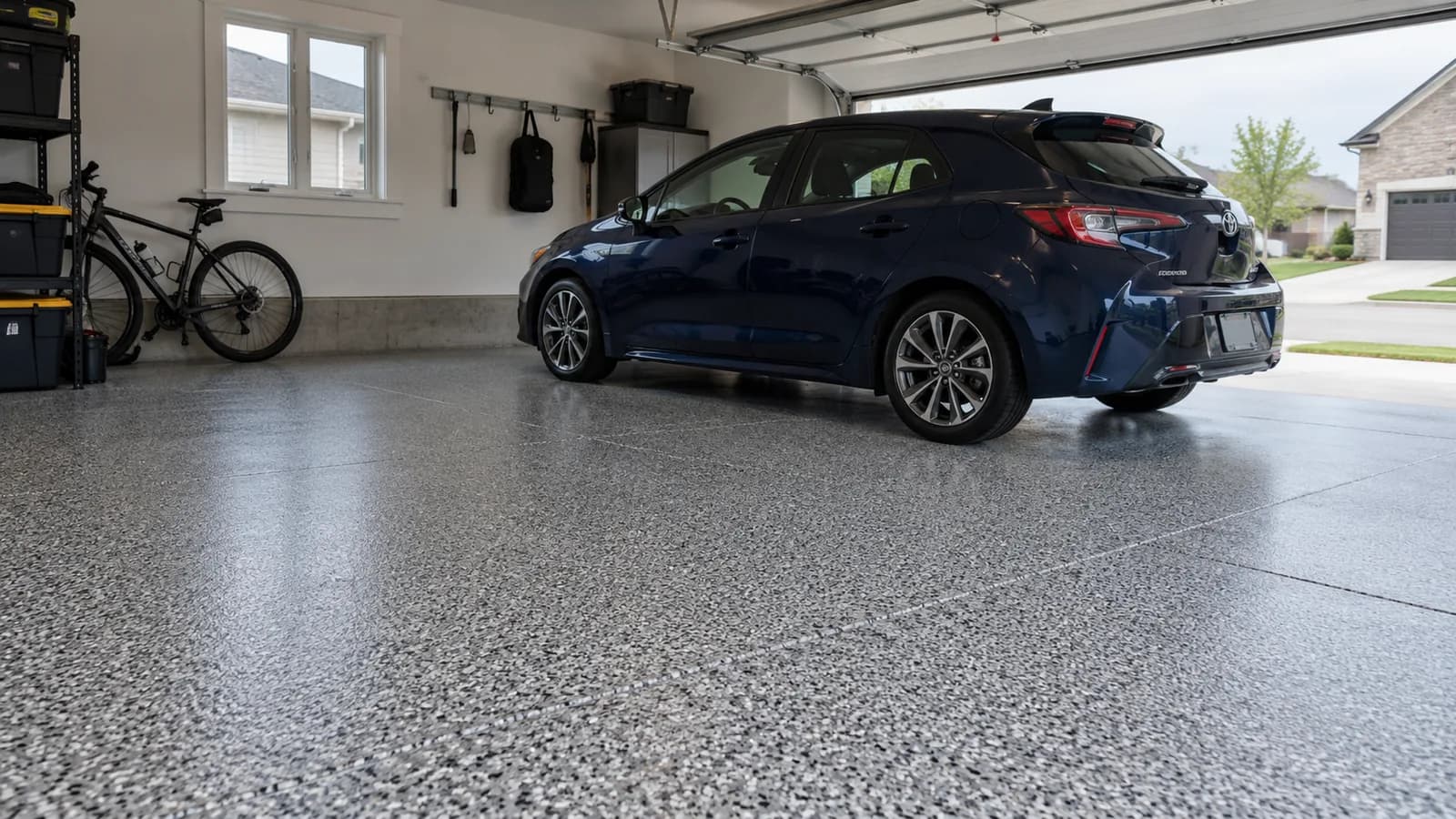
The usual request is a residential garage: one car, two cars, or a deeper bay used for a workshop. The slab may be original to the house or a later pour. Some people want a solid colour. Others want a decorative flake finish that hides small imperfections and adds texture underfoot. A coating quote is also reasonable when an older film is worn but still largely attached, because removal and replacement is a different scope from coating bare concrete.
It is a weaker fit when the slab is breaking up, heaving at the apron, or staying wet for reasons nobody has identified. A coating does not level a settled floor or stop water that enters through a wall or failed drainage. If the concrete itself needs structural attention, say so in the request so the first conversation is about repair rather than colour.
What a Guelph garage actually sees
Southern Ontario winters put road salt, meltwater, and grit on tires. That material ends up on the slab, often concentrated near the overhead door. Summer brings hot tires onto a floor that may also see sunlight at the threshold. An unheated garage swings through a wider temperature range than a conditioned room. A heated garage is a different substrate environment, especially when someone wants work done in cold months.
Those conditions are reasons to name the exposure in a quote, not proof that one brand will survive them. Hot-tire marking, salt staining, and wear at the tire path depend on the film thickness, the topcoat chemistry, how completely the coating cured, and how the floor is cleaned. Ask which product is proposed for the wear surface and what the manufacturer’s data sheet says about tire pickup and chemical exposure.
Epoxy, polyaspartic, and mixed systems
These materials are not interchangeable. A two-part epoxy is often used as a build coat because it can bond to properly prepared concrete and hold a flake broadcast. Many epoxy films can amber or lose colour when they sit in sunlight, so a clear epoxy finish at a sunny door is a design risk worth discussing. Polyaspartic coatings are part of the polyurea family. They are often used as a clear or pigmented topcoat because many formulations are more colour-stable in UV and can return to service sooner. Some full systems are built mostly from polyaspartic or polyurea products instead.
A quote that only says “epoxy garage floor” is incomplete if the wear layer is actually a different chemistry. Read how epoxy and polyaspartic are usually paired, and see polyaspartic coatings when that word is already on your shortlist. Cure time, recoat window, and minimum slab temperature are product-specific. A universal “ready in one day” time is not something a careful quote can promise.
Preparation decides whether it stays down
Professional garage coatings are mechanically prepared. Diamond grinding or, on some slabs, shot blasting opens the paste and removes laitance, weak surface material, and many old sealers. The target is a concrete surface profile in the range the coating manufacturer specifies, often described with the profiles in ICRI guidance rather than with a marketing phrase like “rough enough.” Oil, tire shine, and curing compounds can still interfere after a light grind.
Cracks, spalls, and control joints need a decision before film goes down. Static hairline cracks are not the same as a joint that moves every winter. Filling a moving joint with a rigid product can telegraph a crack through a new floor. Surface preparation and coating cracked concrete go further into those choices. Moisture testing is a separate question when the slab was poured on grade without a known vapour retarder, or when the concrete stays dark after rain.
Flakes, colour, texture, and cleaning
Vinyl flakes are broadcast into a wet base coat, then sealed. A full broadcast hides more of the base colour and usually feels more textured. A partial broadcast shows more of the base and can be smoother. Texture helps with wet shoes, but a very aggressive texture holds dirt. Neither choice is universally safer. If slip resistance matters, ask whether a specified additive is part of the system and how it will change mopping.
Solid-colour floors show tire marks and dust more readily, and they also show waves in the concrete. Metallic effects are uncommon as a garage wear surface because appearance and UV behaviour are harder to keep consistent at a door. Decorative epoxy covers those finishes in rooms where they are more often considered. After installation, cleaning is usually a pH-neutral wash. Strong solvents, steam at close range, and snowplow blades are outside normal care and can damage a film even when the chemistry was a reasonable choice.
What should be on the written quote
Price moves with area, access, the condition of the concrete, and how much material has to come off before anything new goes on. Garage coating cost factors lists the variables without inventing a Guelph price. A useful quote names the work instead of bundling it into one line called “epoxy.”
- Measured area, including whether a step, storage alcove, or the apron is included
- Heated or unheated garage, and any winter timing constraint
- Preparation method and the profile the installer is aiming for
- Crack, spall, and joint treatment, priced so you can see it
- Product names for primer or base, broadcast, and topcoat
- Number of coats and whether a slip-resistant additive is included
- What is excluded: door tracks, vertical faces, drains, or cabinetry
- Downtime described against the product data sheet, not a slogan
- Who would do the work, and whether that company offers a warranty
Questions people ask before requesting a quote
Is a garage floor coating the same as garage epoxy?
People search both phrases for the same project: a coated residential garage slab. Epoxy may be only one layer. Ask whether the quote is an epoxy build coat, a polyaspartic topcoat, a full polyaspartic system, or something else.
Can the floor be coated if it already has paint on it?
Sometimes the old film has to be removed to a sound profile. Coating over a failing paint layer is a common reason new floors peel. The quote should say whether removal is included.
Will a coating stop salt stains forever?
Salt, chemicals, and tires are not promised here for a fixed number of years. A sound film is easier to clean than bare concrete. Damaged or thin areas can still stain or wear.
Do I need moisture testing?
Not every garage needs the same test. Slabs that stay damp, blister an old coating, or have no known vapour retarder are reasons to ask about in-situ relative humidity testing such as ASTM F2170, or another method the manufacturer requires.
Sources checked for this page
Last verified 26 October 2026. Product performance still depends on the system named in a quote and the conditions on site.
- ICRI Guideline 310.2R-2013, Selecting and Specifying Concrete Surface Preparation for Sealers, Coatings, Polymer Overlays, and Concrete Repair
- ASTM F2170, Standard Test Method for Determining Relative Humidity in Concrete Floor Slabs Using in situ Probes
- Canadian Centre for Occupational Health and Safety — chemical hazards